


Knob vs. Touch Screen Gas Water Heaters: Can Better Design Drive Sales in Chile?
Walk through Chile's major online and retail channels and one thing quickly becomes clear: the gas water heater market is far from having only one type of product. Mercado Libre Chile, for example, currently lists a wide range of 10L gas water heaters from brands including Splendid, Rheem, Mademsa, Junkers, Bosch, Midea, Anwo and Ursus Trotter, covering both GLP and GN models, natural and forced exhaust, ionized ignition, digital displays and multiple safety functions.
The market itself is also substantial. Chile imported more than 509,000 instantaneous gas water heaters in 2024, with China, Portugal and Mexico among the main sources. China alone accounted for more than 283,000 units in Chile's reported imports that year.
For brands, however, a mature market creates a new challenge. When consumers can already choose between different capacities, gas types, exhaust systems, safety features and price levels, simply adding another standard gas water heater to the product line may not be enough. Consumers are also becoming more aware of how a product looks, how easily they can control it and how clearly it communicates temperature.
That raises a more interesting question for Chilean gas water heater brands: could better product design become another way to compete for sales?
What Are Chilean Consumers Buying Today?
The traditional gas water heater is still very much alive in Chile. Many popular models use familiar knobs, simple displays and straightforward mechanical controls. This is especially visible in mainstream 7L, 8L and 10L products, where simplicity, price and reliability remain important purchasing factors.
At the same time, the market is not standing still. Digital temperature displays, electronic ignition, overheating protection and water-flow regulation are now common features across many listings. Mercado Libre's current 10L category, for example, allows shoppers to filter products by natural or forced exhaust, ionized or automatic ignition, energy efficiency, digital display, gas-leak sensor, overheating sensor and safety valve.
This shows an important transition: the upgrade is not happening from "old" to "new" overnight. It is happening feature by feature. A traditional knob may remain, while a digital display is added. A natural-draft model may continue selling while a forced-exhaust version is introduced alongside it. And for some brands, touchscreen control is becoming another way to create a more modern, differentiated product.
Knob vs. Touchscreen: What Really Changes for the User?
The difference between a knob and a touchscreen is not simply a question of which one looks more advanced. They create different operating experiences and can support different product positioning.
| Factor | Knob Control | Touchscreen Control |
| Temperature adjustment | Relatively rough, based on position and user experience | More precise, with digital temperature setting |
| Operation | Familiar and simple | More intuitive and visual |
| Temperature information | Often separate or limited | Directly integrated into the interface |
Appearance | Traditional and functional | Modern and minimalist |
Target users | Users who value simplicity and familiarity | Younger, design-conscious and digitally oriented users |
Product positioning | Mainstream / value-oriented | Mid-high-end / differentiated |
Product differentiation | Relatively limited | Higher potential for customization |
Neither control method is automatically better for every consumer. Knob-controlled products can remain highly relevant for older users, traditional households and buyers who prioritize simple operation and proven reliability. Touchscreen products may appeal more strongly to younger families, urban consumers and buyers who care about appearance, precise temperature adjustment and a more modern home experience.
For a brand, the better question is therefore not "Should we replace knobs with touchscreens?"
It is: "Which control design fits this product, this price segment and this customer?"
The Market Is Moving. Should Your Product Line Move With It?
Chile's gas water heater market already has a clear mix of traditional and upgraded products. Mainstream brands continue to offer knob-controlled models, while higher-positioned products increasingly combine digital displays, constant-temperature functions, modulation, forced exhaust and more advanced interfaces.
A brand does not necessarily need to replace its entire existing range. A more practical approach may be to create different levels of product experience:
Entry: Knob control + essential safety features + reliable performance.
Mainstream: Digital display + improved temperature control + upgraded appearance.
Premium / differentiated: Touchscreen + constant-temperature control + advanced safety and a more customized front panel.
This gives brands room to serve different customer groups without abandoning products that already have strong market acceptance.
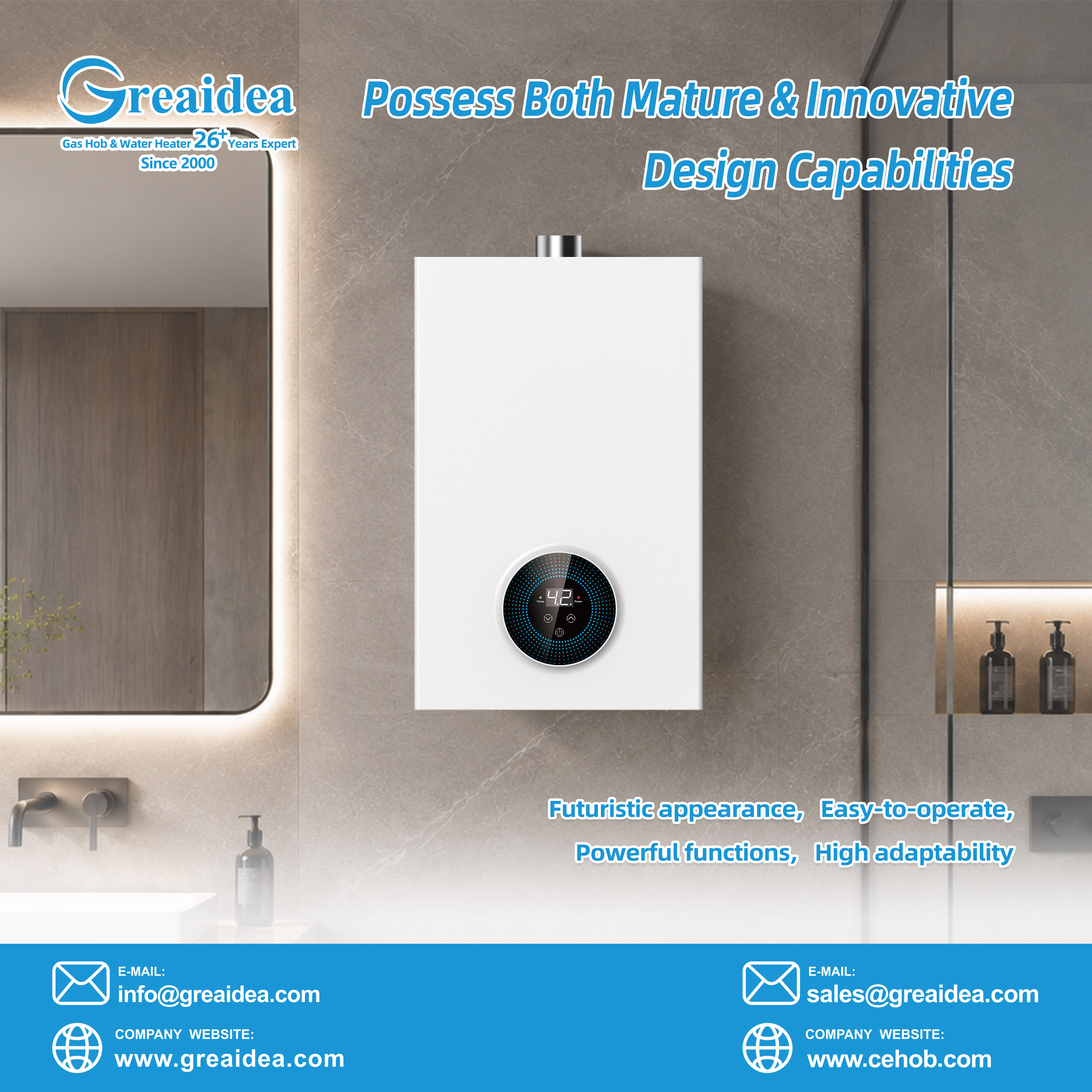
What Should Chilean Brands Upgrade in Their Next Gas Water Heater Line?
When reviewing a gas water heater portfolio, control design should be only one part of the discussion. A stronger product upgrade looks at the complete user experience.
The most important areas to review include:
Control: From traditional knobs to digital and touchscreen options.
Temperature management: From basic adjustment to more precise and stable temperature control.
Appearance: From standard cabinets to cleaner, slimmer and more brand-specific front-panel designs.
Heating and exhaust: From natural draft to forced exhaust and higher-performance configurations where the market requires them.
Safety and efficiency: More comprehensive protection, reliable ignition, stable operation and better energy performance.
This is especially important in a market where brands are competing not only against local names but also against international brands and products manufactured in China. Trade data shows just how important Chinese manufacturing has become in Chile's instantaneous gas water heater supply chain.
So the competitive question is no longer simply where the product is manufactured. It is increasingly about how well the product is developed for the target market.
A Product Manager's Perspective: A Product Line Cannot Stay the Same Forever
A product manager reviewing a gas water heater range that is still selling reasonably well might ask the obvious question: "If the current models are still performing, why change them?"
But a product line cannot remain unchanged simply because today's products continue to sell. Consumer expectations evolve, competitors introduce new features, retailers push for clearer differentiation, and the visual language of the category keeps moving forward.
The goal was never to discard traditional models for the sake of innovation. It was to carefully decide which elements of the product line should stay familiar and which ones needed to advance.
After evaluating the market direction, brand positioning and competitive landscape, the team worked with Greaidea to upgrade the product line—refining key specifications, improving performance and design, and ensuring the range stayed competitive without losing the strengths customers already recognized.
From Market Insight to Product Development: Where Greaidea Fits
For brands planning to upgrade their gas water heater lines for Chile, Greaidea approaches product development from the market backward.
Who is the target customer? What price segment is the product designed for? What does the existing product line already offer? Where are competitors moving? Which features actually create value for the market? From there, product specifications, appearance, control method and configuration can be developed around the brand's positioning.
Greaidea has experience developing gas water heaters for international markets. For the Chilean market, Greaidea's new air-cooled constant-temperature gas water heater has obtained SEC certification, providing a market-oriented platform for brands looking to introduce a more advanced product direction.
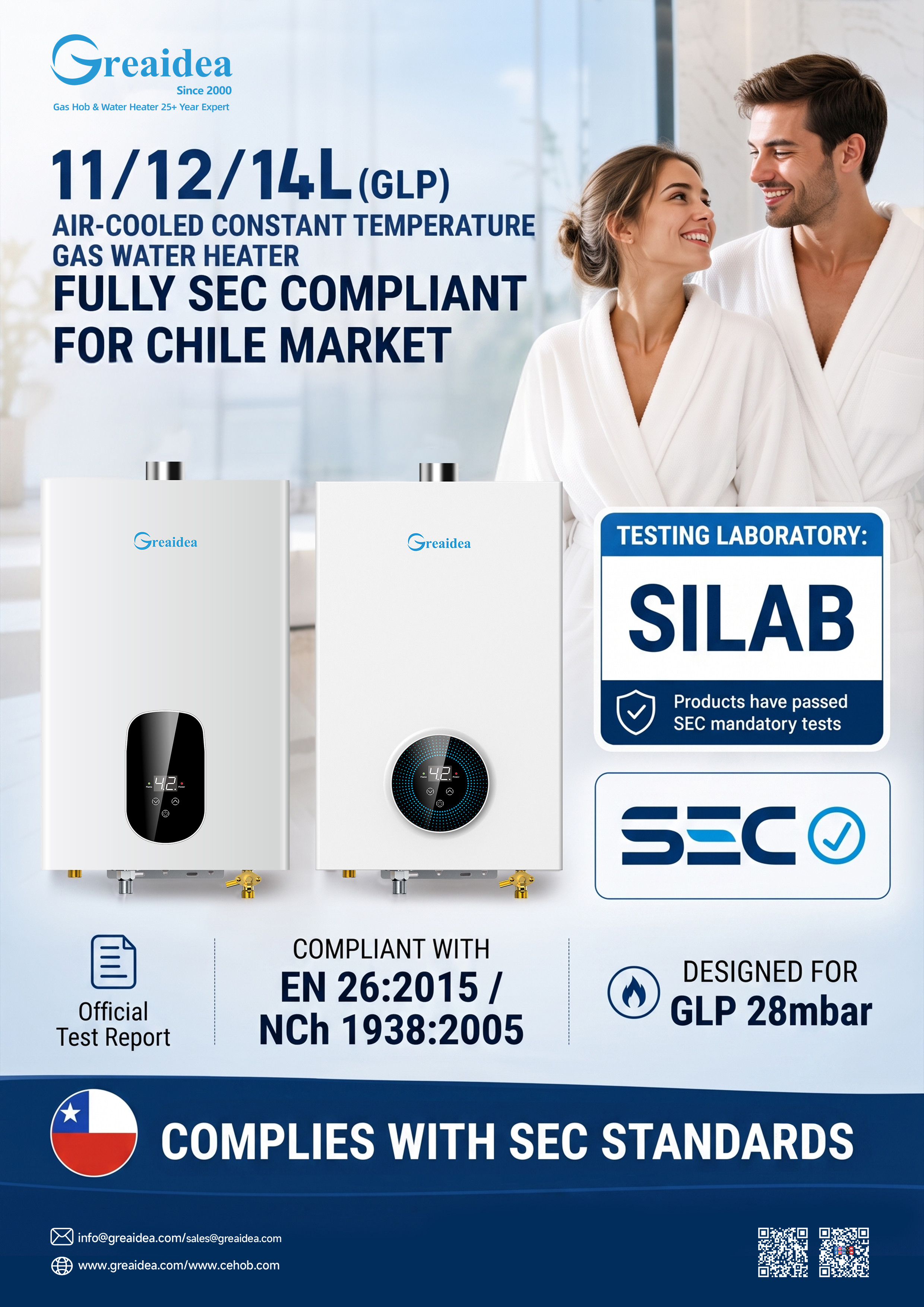
One Platform, Different Product Directions
A brand does not have to choose between "traditional" and "smart" in one step. A more flexible OEM/ODM approach can create a product family around different market positions。
The front panel can also be customized around the brand's visual identity, including appearance, color, display layout, control interface, logo and packaging. This allows the same underlying manufacturing capability to support different brand strategies. For a brand manager, that flexibility can be more valuable than simply having another model number in the catalogue.
What Could the Next Generation of Gas Water Heaters Look Like in Chile?
The future of Chile's gas water heater market will not simply be a story of knobs disappearing and touchscreens taking over. The bigger shift is how consumers define a good product. It is no longer enough to ask whether a heater can produce hot water reliably. Increasingly, buyers also care about ease of control, appearance, intuitive operation and overall value.
For brands, this creates a clear opportunity: better design does not mean adding more technology. It means combining the right control method, appearance and features for the right customer.
The next generation of gas water heaters in Chile will be defined less by whether they use a knob or a touchscreen, and more by how well the entire product experience works together. Looking to upgrade your gas water heater lineup for the Chilean market?
Contact Greaidea to explore practical OEM & ODM solutions tailored to your brand and customers.
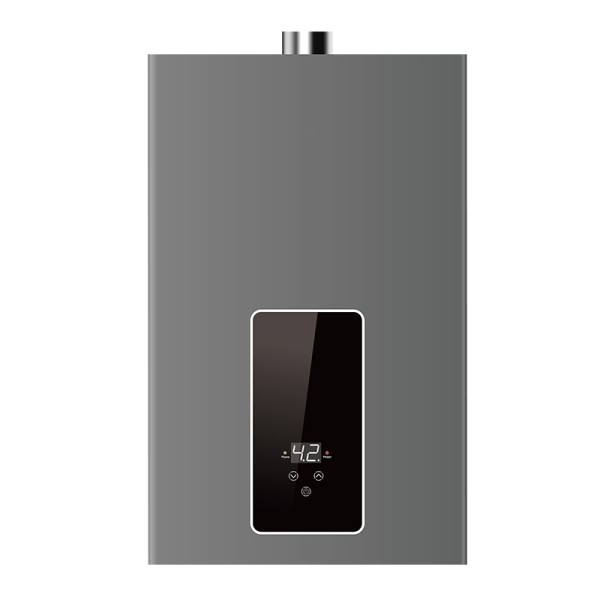
Air-cooled gas water heater with AI temp control, V-shape burner, and dual-speed fan for high efficiency.

A competitive tankless gas water heater with smart control, strong performance and ODM flexibility for global brands.
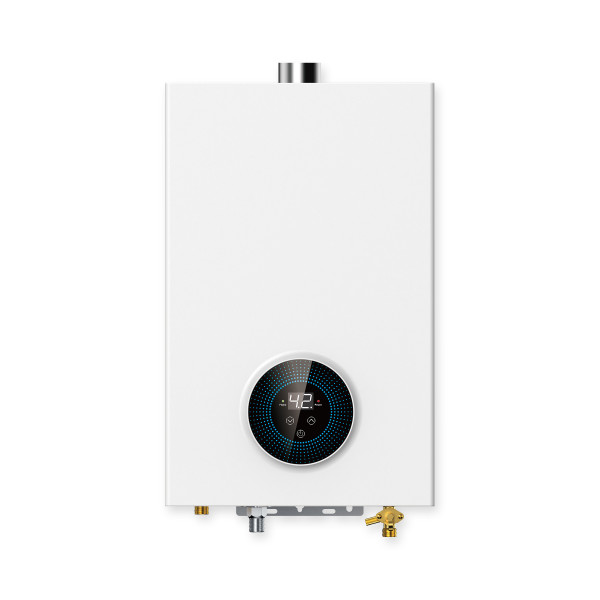
Smart gas water heater with 89% efficiency and touch screen options, designed for flexible ODM brand solutions.

Smart air-cooled instant gas water heater with AI temperature control, premium design and ODM support for brands.